φ→χχ (Monte Carlo)
Run Variables:
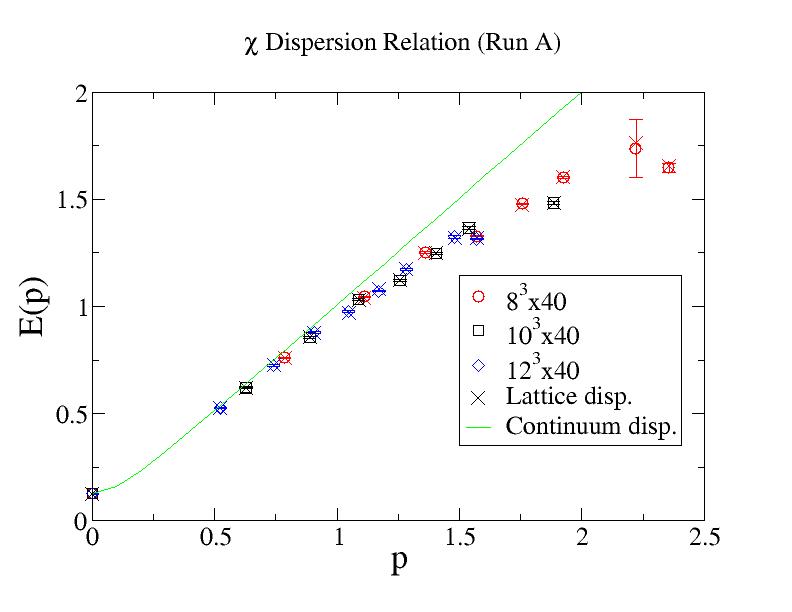
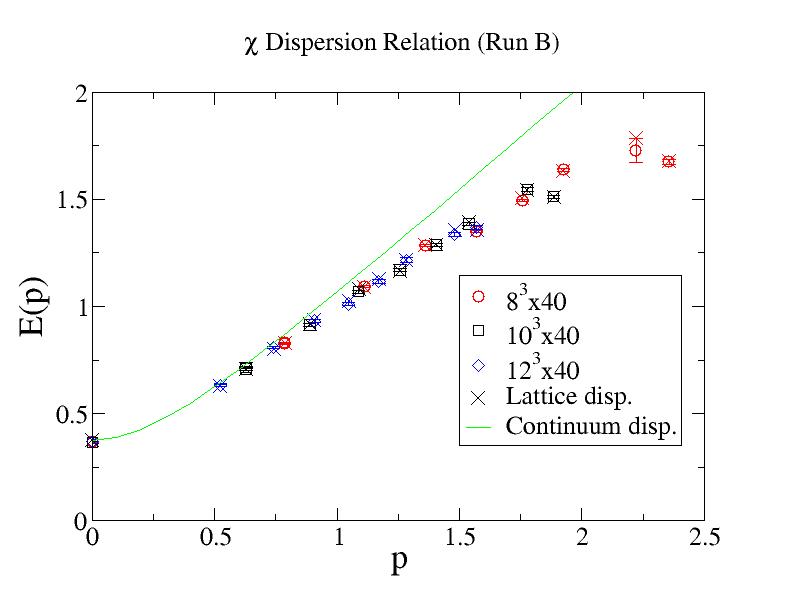
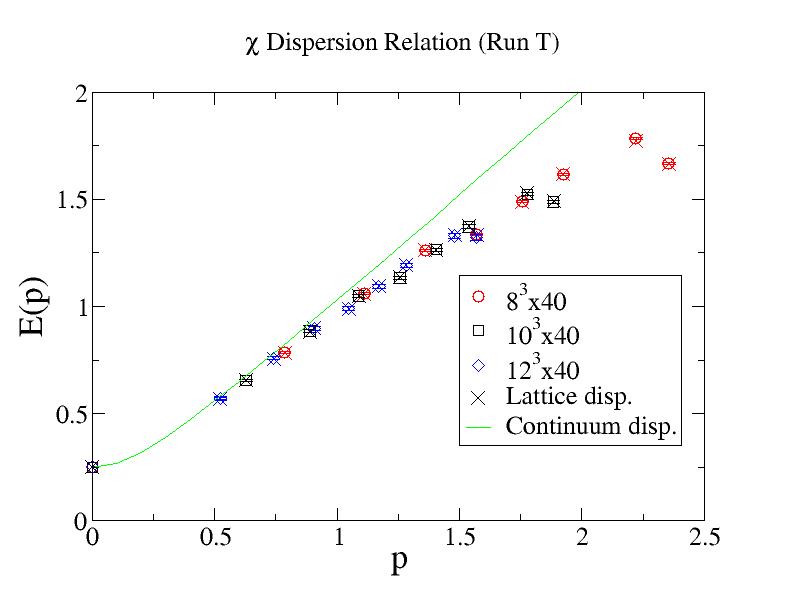
There are three runs; above the mφ=2mχ threshold (Run A), below the threshold (Run B) and on the threshold (Run T).
The parameters for these runs are given below.
|
mφ |
mχ |
r |
λ |
| A |
0.5 |
0.125 |
2 |
0.01 |
| B |
0.5 |
0.375 |
2/3 |
0.01 |
| T |
0.5 |
0.25 |
1 |
0.01 |
χ Dispersion Relation:
Firstly, we look at the dependence of the χ energy spectrum on the momentum, p, of the χ field.
We measure the χ mass at a range of momenta on 83x40, 103x40, 123x40 lattices.
The momenta used were 0, (1, 0, 0), (1, 1, 0), (1, 1, 1), (2, 0, 0), (2, 1, 0), (2, 1, 1), (3, 0, 0), (2, 2, 0) and (0, 1, 0).
Below are the dispersion relations for the three runs, together with the corresponding lattice and continuum relations.
Operators:
The next step is to construct operators on the fields. This has been done with much weeping and gnashing of teeth and the details will be included as
soon as I tex them up. The construct has to be repeated allowing for subtleties that arise in the case where the φ field is integrated out.
From these operators, we can construct a correlation matrix.
Correlation Matrix:
Armed with our newly calculated, we now
- Diagonalise the matrix.
- Analyse E0, E1, …
Decay Width:
- Repeat at different V=103, 123, … (Cubic lattice)
- Repeat at different V=82x10, 82x12, … (Brick lattice)
- Calculate scattering phase shift from energy spectrum.
- Recover decay width from scattering phase shift.
- Examine wave function behaviour.
φ→χχ (Perturbation Theory)
At the moment, avoided level crossings are seen when the temporal extent of the lattice is changed.
We need to investigate crossings when the spacial extent is changed.
Once this is done, we can follow the same line as the MC case.
It would be an ideal sandbox to get used to extracting the phase shift/width from data and also compliment the MC data nicely.
It might be worthwhile having another run (call it Run S for strong though this is probably a bad name) with λ =1 or some very big value.
Hopefully we could see the perturbation theory fail compared with the MC data.
The only problem might be having to tune the MC data due to a higher renormalisation.
QCD
This will be necessarily vague. I'm just working off a few notes I have scratched in my notebook. Anyway…
- π operators
- 2π operators
- π(0)π(0)
- π(1, 0, 0)π(-1, 0, 0)
⋮
- π(2, 0, 0)π(-2, 0, 0)
- σ, f0 (I=0, JPC=0++)
- ψψ
- ψ∂ψ
Thesis Layout
- Introduction
- Decays/Model
- Perturbation Theory/MC Simulation of φ→χχ
- Results/Analysis of φ→χχ
- QCD
- Conclusions