


Top Spin of a Quark: A Puzzle?
Nigel Buttimore
Abhay Deshpande


 A Supercluster of Galaxies
 a Galaxy a billion times lighter
 a gigametre Star
 a megametre Asteroid
 a kilometre Hill
A kilometre Hill
 a Bear a billion times lighter
 a millimetre Fruitfly
 a micrometre Cell
 a nanometre DNA base pair

WILLIAM ROWAN HAMILTON
Bicentenary (1805 - 1865)
Dublin University Review 1833
- mathematicians will deduce all properties of
optical systems from the function V
- an analogous function of the planetary orbits
I gave a short notice of in the XVth volume
of the Transactions of the RIA

- this view
appears to open in mechanics and astronomy
an entirely new field of research.
Observatory of Trinity College Dublin
September 1833
Hamiltonian methods became important for
Quantum and String theories.
WILLIAM ROWAN HAMILTON
presents to the Edinburgh BA Meeting of 1834
"On the Application to Dynamics of a General
Mathematical Method previously applied to Optics"
a unified approach to an understanding of Light and Matter.

GEORGE FRANCIS FITZGERALD
"the length of material bodies changes
by an amount depending on the square of
the ratio of their velocity to that of light."
Letter published in Science in May 1889

ALBERT EINSTEIN (1879 - 1955)
Submitted to Annalen der Physik
on 27 September 1905
Does the Inertia of a Body depend upon its Energy-content?
"The results of the previous investigation lead to a very interesting conclusion, based on Maxwell-Hertz equations ... "

"The mass of a body is a measure of its energy
content; if the energy changes by L,
the mass changes in the same sense by L / c²
It is not impossible that with bodies whose
energy-content is variable
the theory may be successfully put to the test."
The E = m c² prediction of Einstein in 21 November 1905 was confirmed by the 1932 experiment of Cockcroft and Walton.

SPIN
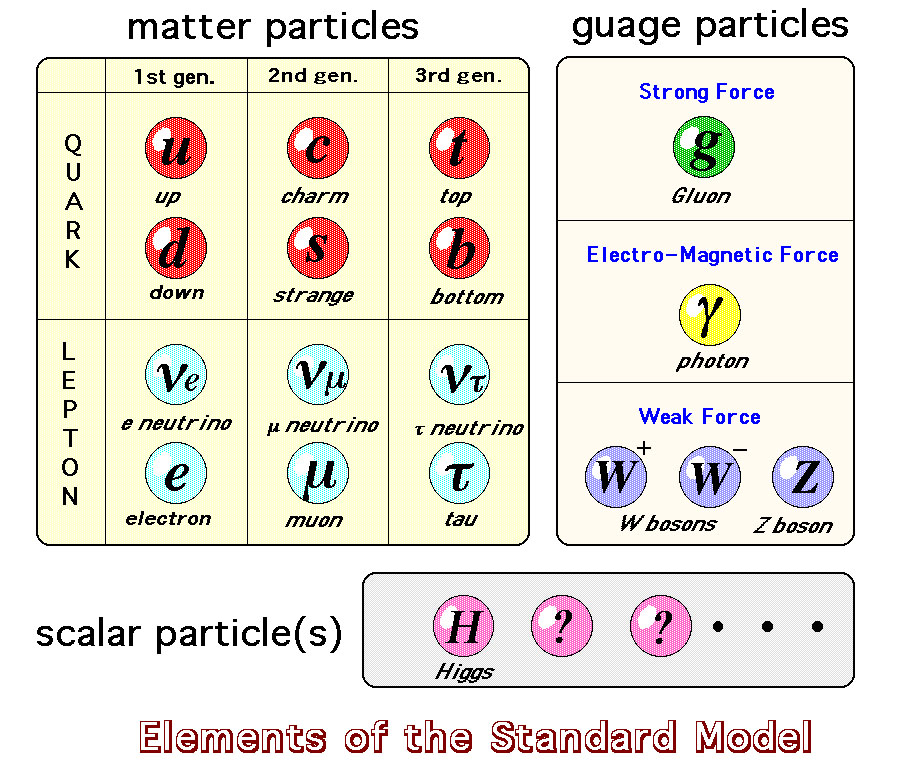
Quantum and Relativity theories lead to
spinning particles and anti-particles.
The constituent quarks contribute only about
2% of the mass of a proton; the bulk comes
from the energy of motion within the proton.
Probing the spin of a proton will reveal its structure.
At the still points of the turning world are the arctic and the antarctic.
SUMMARY
The naked eye can see items larger than about 4% of a millimetre.
Microscopes using light reveal details of micrometre dimensions.
Swift particle beams have probed objects of
nanometre (1897), picometre (1932), femtometre (1955)
and attometre (1999) sizes.
Studies of structure below the attometre scale
during this century promise to
increase greatly our understanding of the universe.